Solutions-Engineered

Engineered Pathway to Carbon Removal
Carbon removal designed for long time horizons
Equilibrium's biochar projects span two models converting waste biomass into verifiable carbon removal through industrial facilities built for volume, long-term durability and premium registry-grade credits; and a decentralised artisan network built for community reach, measurable co-benefits and impact-linked issuance.
WHAT BIOCHAR DOES
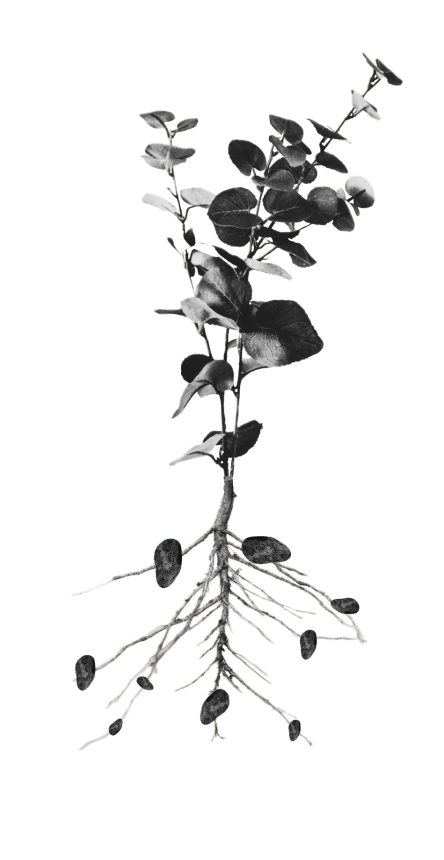

Loads Nutrients
High cation exchange capacity locks minerals into a stable carbon matrix. Nutrients stay in the root zone, not lost to leaching

Two operating models. One principle: durable carbon removal designed to endure across landscapes, systems, and time horizons.
Industrial facilities provide scale and long-term permanence. Decentralised networks extend participation, resilience, and measurable local impact.
Both are anchored to the same non-negotiables: technology-integrated, audit-grade integrity from biomass to credit.
OUR OPERATING PHILOSOPHY ENCAPSULATES THE SPIRIT OF BEING:

Technology selected by feedstock type and regional context consistently producing biochar with H/C ratio between 0.1 - 0.3 that qualify for hundreds of years of carbon storage. Permanence is not assumed. It is measured, sampled, and independently verified at registry endorsed and accredited laboratories.
HOW WE BUILD EVERY PROJECT
RESEARCH AND DEVELOPMENT
Indian agricultural soils are under sustained stress depleted by decades of chemical inputs, degraded by erosion, and increasingly unable to retain water or support yields. Equilibrium runs exhaustive trials across agro-economic zones, testing proprietary formulations by feedstock type, pyrolysis conditions, and soil profile. The goal is not biochar in general. It is the right biochar, for the right soil, in the right place.
APPLICATION
Producing high-integrity biochar solves half the problem. The other half is ensuring it reaches the farmers whose soils need it most. Equilibrium works directly with farming communities to embed biochar as a practical agricultural input building the demand, the market infrastructure, and the ground-level evidence that turns adoption from aspiration into standard practice.
PROJECTS
CATEGORIES
PROJECTS
TITLESATYAPURA BIOCHAR PROJECT
PROJECT IDTS26
FIRST CREDIT ISSUANCEJanuary 2026
REGISTRYISOMETRIC
DESCRIPTION
Equilibrium's first industrial-scale biochar facility, a purpose-built, greenfield continuous pyrolysis plant in Rajasthan.

TITLEMURUDAGIRI BIOCHAR PROJECT
PROJECT ID219121
FIRST CREDIT ISSUANCEQ2 2026
REGISTRYISOMETRIC
DESCRIPTION
Operating at 56 tonnes per day in Karnataka's Gadag district, Murudagiri transforms agri-residues and invasive biomass into long-term climate value.